

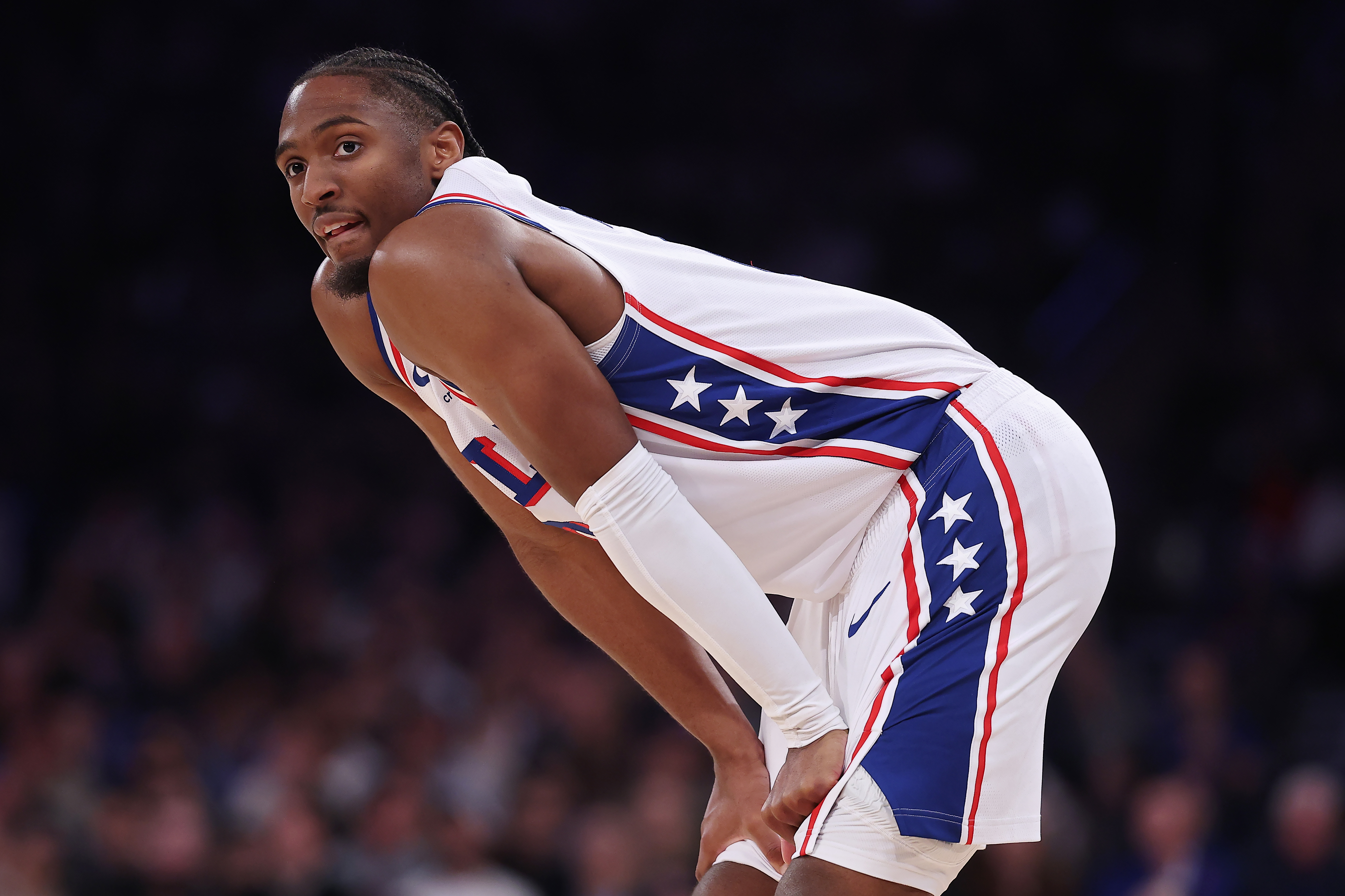
Tyrese Maxey saw it coming.
Less than four minutes into Game 2, he’d just rebounded a missed corner 3 by Josh Hart and turned upcourt. With his Philadelphia 76ers trailing by one — in both the game and the series — he knew he needed to make something happen. And he knew the New York Knicks weren’t particularly keen on letting him do that.
As he crossed half-court, Maxey was greeted by the placid countenance and exceedingly long arms of Mikal Bridges, his primary matchup for nearly all of the first two games of the Eastern Conference semifinals. They faced off as Maxey dribbled on the right wing, about 35 feet away from the basket, and called for a ball screen.
Andre Drummond ambled up to set it. That’s important, because while Andre Drummond is a great many things — a historically excellent rebounder, a person nicknamed “Big Penguin” for reasons even he doesn’t understand, someone who became a shockingly good corner 3-point shooter 14 years into his career, etc. — he is not Joel Embiid.
Embiid, even in his injury-ravaged form, remains one of the most lethally efficient scorers in the world — someone you’d have to worry about torching your defense if you left him alone. Drummond, corner triples and tip-toe tip-ins aside, is not. But Embiid wasn’t available in Game 2, so, here comes Andre.
This is why, as Drummond approached Maxey, his defender did, too. Rather than playing drop coverage in the pick-and-roll — a tactic that would call for him to stay below the level of the screen and sink back toward the paint, with walling off a drive and protecting the rim as his primary objectives — Karl-Anthony Towns sprinted up toward the sideline, stationing himself on Maxey’s right-hand side.
Before Drummond could even fully set his screen, Maxey leapt and fired a pass across the width of the court to Paul George. He quickly swung it to Kelly Oubre Jr., guarded by Jalen Brunson — the weak link on a New York defense that has ranked fourth in the NBA points allowed per possession since Christmas, and someone the Sixers want to attack whenever possible.
As Oubre, much more comfortable finishing plays than creating them, drove toward the paint, OG Anunoby sliced his right hand into Oubre’s dribble. The pressure led Oubre to lose the ball, which squirted out into the aforementioned exceedingly long arms of Bridges. Possession over; threat neutralized.
It’s just one relatively innocuous possession in a game filled with plenty of other twists and turns that produced a 108-102 Knicks win. But it’s instructive, because it laid bare how New York wants to deal with Maxey — especially when Embiid isn’t available, and it’s unclear if he will be for Game 3 on Friday.
“Mainly, they were just putting two on the ball, you know what I mean?” Maxey said after Game 2. “Every ball screen, every action, every switch, they would just put two on the ball, and I was just getting rid of it, getting off of it. Yeah, that’s really it. I was just trying to create and do different things like that, and just use my gravity.”
By putting two defenders directly in Maxey’s path, the Knicks aim to make him make a decision: Either try to navigate through that traffic, or pass the ball away to a teammate. If he opts for the former, New York can deploy its long arms and physicality to make it tough for Maxey to find open space, thus potentially forcing a contested look or a turnover. (On the highlighted possession, with Bridges positioned to Maxey’s left, the Knicks are looking to force the ball down the sideline, “icing” the pick-and-roll to keep the ball out of the middle of the floor. If Bridges opens his stance up, with Towns stationed on Maxey’s right, they could work to force him to his non-dominant left hand — a strategy called “weaking” the pick-and-roll — with Anunoby waiting at the nail and poised to spring help.)
And if Maxey goes with Option B … well, then a non-All-NBA player is the one commanding the 76ers’ offense, which is an outcome the Knicks are just fine with, thanks.
“I think Tyrese is so good that obviously he’s gotta require a trap,” said Edgecombe, who scored 17 points on 6-for-13 shooting in Game 2, but committed four turnovers against three assists in his 40 minutes of floor time. “I think they just wanted someone else to beat them, regardless of who it is. Just not Tyrese.”
The Knicks sprinkled in some dialed-up aggression on Maxey in Game 1, with mixed results …
… but head coach Mike Brown didn’t lean too hard in the direction of bringing the heat, due at least in part to the presence of the former MVP looming as a potential source of pain. In Game 2, though, with Embiid out and an understanding that the Sixers’ best chance of getting even was Maxey going nuclear, Brown decided it was time to bring the house.
“You know, if you give a great player the same dose of coverage the whole game, he’s gonna tear you apart,” Brown said after Game 2. “And so, you know, we went to some blitzing and double-teaming him, and then we took it off, then we put it back on. You have to do that.”
The Sixers did have some success playing out of those traps in Game 2, with Maxey able to hit a release-valve teammate in the pocket to play 4-on-3 or kickstart swing-swing sequences leading to either open looks or drives against rotating defenders:
“I thought our guys did a really good job of making the right reads,” 76ers head coach Nick Nurse said after Game 2. “I thought we passed the ball good.”
But the Knicks got what they were looking for out of the cranked-up pressure on plenty of trips, too, whether by jumping the passing lane after the trap to force a turnover or just by forcing another Sixer to make enough plays and shots to beat them:
“When you do blitz, or when you do double-team, you have to be OK saying, OK, you know what?” Brown said after Game 2. “If other guys make shots, like some of the other guys were tonight, and you lose, then hey, you pat them on their back and you tell them, ‘Good game,’ and you go to the next one.”
Philadelphia’s “other guys” couldn’t make enough of those shots in the fourth quarter. George, Edgecombe and Oubre combined to go 1-for-11 from the field in the final frame, part of a dreadful 4-for-19, 12-point finish that allowed the Knicks to escape with the victory.
“I thought we had maybe four wide open shots in a row that didn’t go,” Nurse said. “We needed to keep the scoreboard moving. We played great offense. We just didn’t shot-make.”
Against the Celtics in Round 1, Maxey’s pick-and-rolls — including possessions on which he passed to a teammate who shot, drew a foul or committed a turnover — generated 1.04 points per possession, according to Synergy Sports Technology’s tracking. That would’ve been a near-top-10 mark among high-volume ball-handlers during the regular season. Through two games against New York, though, that’s down to 0.972 points per possession — a good-but-not-great mark that would’ve been closer to bottom-10 in that high-volume cohort — with those possessions ending in a turnover 25% of the time when the Knicks commit a second defender to the action
Several of those turnovers came after Maxey “kind of jammed [his right pinky] finger in the second quarter” of Game 2 — an issue that he said left him feeling less confident than usual in his handle and ability to dribble around or split the Knicks’ traps.
“So I was just trying to get off the ball and, like, create actions,” Maxey said. “But that’s fine. They can put two on the ball. I’m fine with that. We’ve just got to get more comfortable making the reads. And I’ve gotta — I turned the ball over way, way, way too much tonight, especially out of the traps, and I’ve gotta do a better job of just staying poised in those traps and make the right play out of it.”
Sometimes the right play is for Maxey to shoot it himself. He went 2-for-7 from the floor in the fourth quarter, though, and 3-for-9 in the second half — a dramatic shift from a red-hot second quarter in which he scored 15 of his team-high 26 points, repeatedly attacking whenever he was matched up against smaller Knick defenders like Miles “Deuce” McBride and Jose Alvarado. So, what changed after intermission?
“Mikal Bridges,” said Knicks forward Josh Hart. “He did what he does, and he took that challenge. And that’s why that’s our guy. He gave amazing effort.”
“On the defensive side of the ball, I think [Bridges is] just making things tough,” said Brunson. “I also think Tyrese is generating some good looks for himself and for others, but we’re just trying to make it as tough as possible, because obviously the things he can do are pretty spectacular.”
Bridges was a bit more demure in assessing New York’s second-half success than noted hype-man Hart: “I think we just all adjusted and showed a little more shifts, a little more bodies for him.” Brown, for his part, saw the answer as being somewhere in the middle.
“You know, you’re not stopping Tyrese Maxey,” Brown said. “I mean, Tyrese, he had a great game. He had 26 points. But Mikal tried to make him work, especially in the second half, for every point he got, and I think he ended up with seven in the second half. And, you know, you’re going to have to keep working and give multiple efforts, and the team defense behind him is going to have to be great in order to even think you’re going to slow him down, because he’s a great player. But Mikal did what he could, as well as everybody else behind him.”
They did it, in part, because they weren’t just behind Bridges — they were alongside him, and in Maxey’s face, heating him up at every opportunity.
“They trapped me aggressively, you know what I’m saying?” Maxey said after the game. “They, like, really, really trapped me. It wasn’t like a soft trap. So when they trapped me, they trapped me. It was my fault a couple of those times — a lot of those times. And I’ll be better with that.”
He’ll have to be, especially if Embiid’s unable to return or limited in his ability to make an offensive impact when he does. Needing to win four times in the next five games is a tall enough order. Doing it while facing constant double-teams for nearly the full 48, though — and while your former backup point guard is currently lighting it up in Oklahoma City — is a whole new level of pressure.
“It’s going to be like this for the rest of the series,” Maxey said. “I don’t expect anything less.”
