

In case you weren’t around for Ronda Rousey’s first exit from the world of mixed martial arts fighting back in 2016, let me give you a sense of how it went down.
First she was unbeatable, the messiah who led women’s MMA into the promised land known as the UFC. Then she got knocked out by Holly Holm at UFC 193 and was later seen hiding behind a pillow at LAX, which made for a pretty sharp contrast from her days as the swaggering champ with the sharp tongue. She made one stab at redemption the following year and was brutalized by Amanda Nunes, at which point the entire MMA world basically pointed and laughed and hit share on endless mocking memes.
And that was it. Rousey was seen no more in the UFC. Her entire professional career lasted just a shade over five years, yet changed the entire landscape of women’s MMA. She was a meteor, streaking through the sky in a flash of light that was as brilliant as it was brief.
But in the years that followed, Rousey never quite got the nostalgic, retroactive love from fans that so many other retired fighters do. A big part of that was the way she went out. She lost two straight and then ran away to hide. That was the perception, anyway. And Rousey knew it as well as we did.
To hear her tell it on Monday’s episode of “The Ariel Helwani Show,” her exit from the sport was less a choice than a necessity. An undiagnosed neurological condition essentially forced her out, and on the heels of two awful performances against Holm and then Nunes.
“The very first time I got hit in that [Holm] fight, it knocked all my lower teeth lose and cut my lower lip open,” Rousey told Uncrowned. “I got this huge — now I know it was a migraine aura, which is a big chunk of my vision basically missing. … I lost my depth perception. I lost my ability to think quickly or be able to track moving objects. But I was still on my feet and balanced. I’ve been trained my whole life to not show when you’re hurt.
“That entire fight was me basically trying to hide the fact that I couldn’t see and couldn’t think.”
Against Nunes, Rousey said, it happened again. She took a bad beating in the fight, not to mention a second straight loss that put her even further from the title that she’d once defended five consecutive times with five consecutive finishes. But what really stung, she said, was knowing how her career would be judged by these two losses at the end — and knowing that she was now unfit to get back in the cage and do anything about it.
“I just felt like I was judged on my fighting ability and my fighting IQ, because of what was happening when I was dealing with not being able to see,” Rousey said. “And just knowing that my career was over because of it, and that no one could understand. People were making all these kinds of judgments about me and my fighting ability because of it, and I would never be able to set it right after that because it got to the point where I couldn’t even get hit anymore.”
Since then, Rousey said, she sought treatment at the Cleveland Clinic, and even got on some “life-changing” medication. It helped her reinvent herself as a pro-wrestler in the WWE, and has allowed her to make an MMA comeback against Gina Carano at Saturday’s MVP MMA event on Netflix.
But there’s still that lingering question: Do we owe Rousey’s body of work a reexamination? We were unfairly harsh to her at the time? Does her MMA legacy deserve better than the treatment it’s gotten over the last decade?
There are bound to be those who say no just based on skepticism toward her explanation. Migraines? Really? Plus, doesn’t every fighter have their own excuses after a loss? If you let them tell it, no MMA fighter has ever legitimately lost a fight. This is nothing new.
Rousey, for her part, seems resigned to that response. “There’s a lot of people out there who think I’m making it up or don’t believe me or whatever,” she told Helwani. “Neurological problems are an injury that nobody else can see.”
Say the truth is somewhere in between. Let’s say, for the sake of argument, that it was neurological problems that convinced Rousey to take her money and go home, but she wouldn’t have beaten Holm and certainly not Nunes no matter how clear-eyed she’d been. Call it the natural evolution of the sport. Like many groundbreaking pioneers who were once way ahead of the game, say the field caught up to her and then passed her by.
Didn’t more or less the same thing happen to Chuck Liddell and Anderson Silva and B.J. Penn and a dozen others we could name? The difference is that they kept going, most of them for way too long, so we essentially mourned the fighter they’d once been while the reanimated corpse of that same guy kept showing up and losing. Didn’t Rousey do what we said we wanted from those others, which is know when to quit? Were we really just mad that she didn’t stick around to take our abuse in person? How dare she make a clean getaway just when she’d finally been humbled.
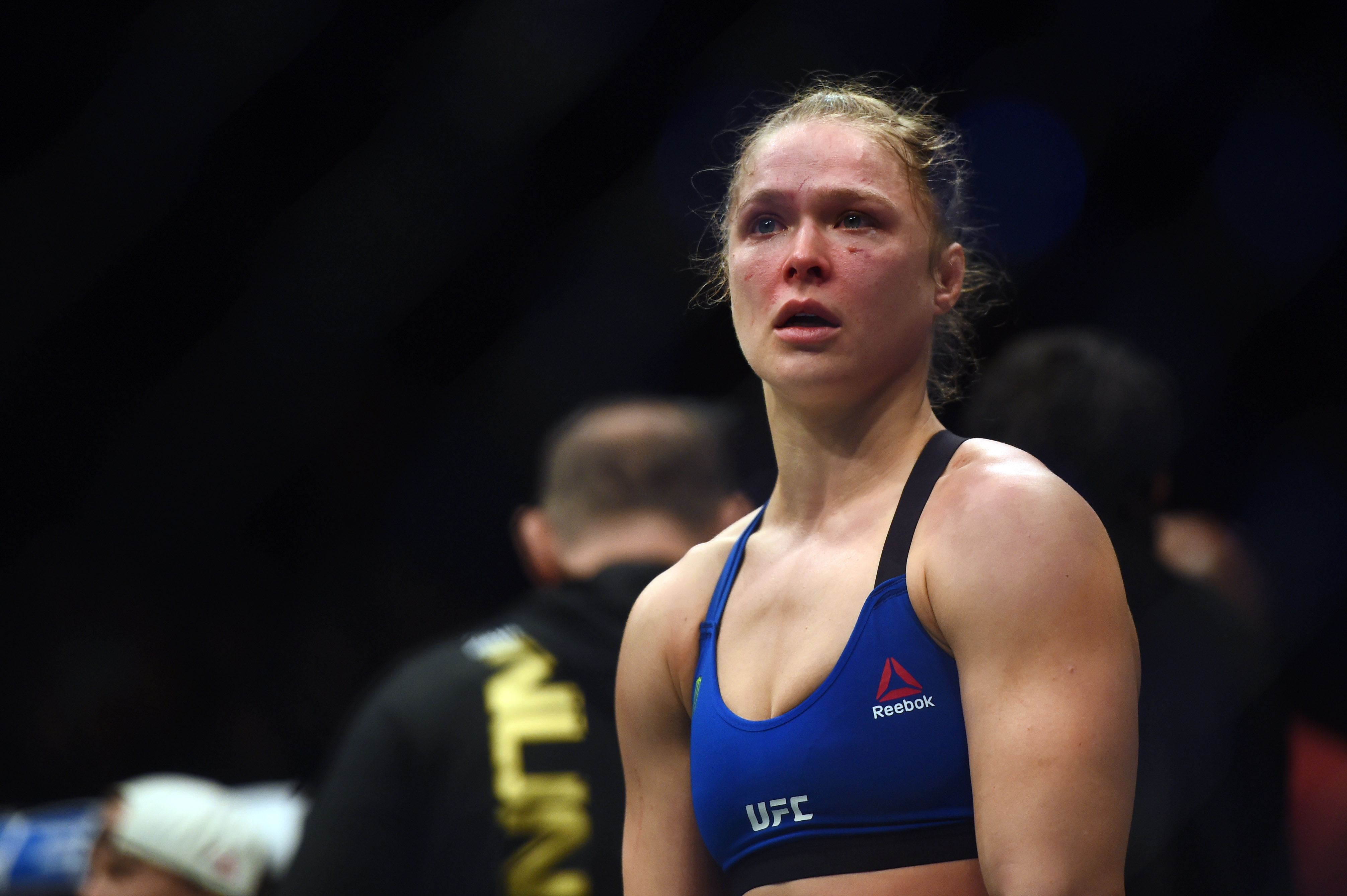
In that sense, yes, I think we have to say she deserved more love than she got there at the end. And she might have gotten it if she could have only forced herself to ask for it. But she left suddenly and angrily, she said, in part because she didn’t feel she’d been able to give a full accounting of herself.
“I just thought I would be forever misunderstood and only known for those performances,” she said this week.
But that’s the other thing about the way Rousey’s career ended. She had a lot to say when she was on top. She was not known for being terribly gracious to her opponents — before or after the fights. Her chosen theme song included Joan Jett screaming “I don’t give a damn about my reputation.” This was not someone who could ever admit to wanting our respect or admiration.
So when she disappeared as soon as the going got rough, and only popped back up every once in a while to fire shots at the media and the commentators who she felt had failed to give her the credit she’d earned, it didn’t exactly help herself in that ongoing legacy battle.
How about now, though? In the lead up to her return against Carano on Netflix, are we ready to admit that Rousey probably deserves to be remembered a lot more for the peak of the highs than the valley of the lows?
She was, in her time, a colossal force in this sport. She picked up women’s MMA and heaved it forward. But she also did something similar for the UFC itself, and for MMA as a whole. That meteor lit up the whole sky and helped many, many people see what was hiding in this little dark little corner of the world. The fact that she can still light up this world now, even from without the UFC, proves that there was more to her than a couple bad nights in the cage.


